Temple of Domitian Informations
The Ephesians built this temple to show their gratitude to the facilities provided by the Emperor Domitian. Domitian was the first emperor to be built on behalf of Ephesus.
When the cult statue in the temple was destroyed by the adoption of Christianity, there is no part of the head and arm sections that have survived to the present.
Quick Facts
- Location: Domitian Square, Upper Ephesus, between the State Agora and Curetes Street
- Period: late 1st century AD, dedicated approximately 89–90 AD
- Dedicated to: Emperor Titus Flavius Domitianus (reigned 81–96 AD)
- Civilisation: Roman Imperial
- Status: ruins; foundations and partial columns survive
- Original cult statue: estimated 7 metres tall, fragments displayed at the Ephesus Archaeology Museum in Selçuk
History & Significance
The Temple of Domitian holds a particular place in Ephesian history: it was the first temple built in the city for the cult of a Roman emperor. The honour was significant for Ephesus, because acceptance as a neokoros (temple-warden city) of the imperial cult raised the city’s political and religious status across the province of Asia. Ephesus would later become a four-times neokoros, but Domitian’s temple is where that prestige began.
Construction was completed around 89–90 AD, during Domitian’s reign. The complex stood on an artificial terrace measuring roughly 50 by 100 metres, supported by a vaulted substructure that survives in part today. The temple itself was a pseudo-dipteros, an arrangement of columns where the inner row of the colonnade is omitted, leaving an unusually wide gap between the columns and the cella wall. The façade likely had eight columns; the long sides had thirteen.
Inside the temple stood a colossal cult statue of the emperor. Surviving fragments include the head, forearm and parts of the hand. The head alone measures roughly 1.18 metres in height, and reconstructions suggest the seated figure stood about seven metres tall in total. These pieces are now displayed in the Ephesus Archaeology Museum in nearby Selçuk and are among its most photographed exhibits.
After Domitian’s assassination in 96 AD, the Roman Senate condemned his memory (damnatio memoriae). His name was erased from inscriptions across the empire, and the temple at Ephesus was rededicated to his father Vespasian, founder of the Flavian dynasty. For much of antiquity it was officially the Temple of the Flavians, though modern scholarship and signage still refer to it as the Temple of Domitian. Christian iconoclasm in late antiquity led to further damage, including the destruction of the cult statue.
What to See
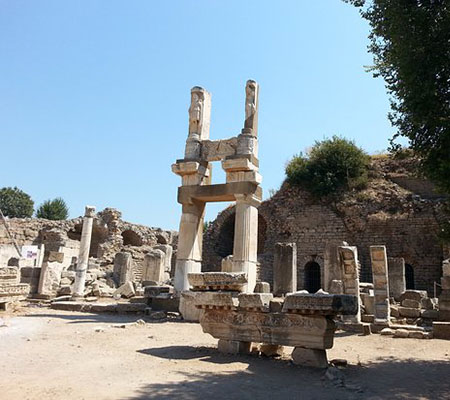
Today the temple area is best understood as an architectural footprint rather than a standing building. The vaulted substructures on the southern side of Domitian Square are the most striking surviving element — visitors can walk along the base and see the heavy masonry that supported the terrace above.
A handful of restored columns and column capitals stand along the edge of the platform. The carved blocks on the ground around the site include fragments of friezes and architectural decoration. Adjacent to the temple terrace is the Pollio Fountain (Fountain of Pollio) and the Memmius Monument, both worth a look as you explore Domitian Square.
For the full picture, plan to combine the temple visit with a stop at the Ephesus Archaeology Museum in Selçuk, where the colossal head and arm of the cult statue are displayed in good lighting. Seeing the fragments at the museum and the foundations on site brings the scale of the original complex into focus.
Visitor Information
Opening Hours
The Temple of Domitian is part of the Ephesus Archaeological Site, which is generally open daily. As of 2026, summer hours (April to October) run approximately 08:00 to 19:00 (last entry around 18:00). Winter hours (November to March) run approximately 08:30 to 17:00 (last entry around 16:00). The site closes only on a small number of public holidays. Always verify the latest schedule on muze.gov.tr.
Tickets & Entry
There is a single ticket for the entire Ephesus archaeological site, with the Terrace Houses requiring a separate supplementary ticket. As of 2026, the Ephesus standard entry fee is approximately 40 euros equivalent, although prices are revised annually and you should check the official site for current figures. The MuseumPass Turkey and MuseumPass Aegean both cover Ephesus and are worth considering if you plan to visit multiple ancient sites. Audio guides are available for hire near the upper and lower gates.
How to Get There
Ephesus is located near the modern town of Selçuk in İzmir Province on Turkey’s Aegean coast. From Istanbul:
- By air: one-hour flight to İzmir Adnan Menderes Airport (ADB), then a 45-minute drive south to Selçuk
- By rail: high-speed train connections via Ankara are not direct; flying is faster
- By road: approximately 8–9 hours by car, around 600 km
From Kuşadası port (a common cruise stop), Ephesus is a 20-minute drive. From İzmir city centre it is about 70 km south. The site has two entrances — Upper Gate (Magnesia Gate) and Lower Gate. The Temple of Domitian is closer to the Upper Gate, so visitors who start at the top can walk downhill through the site and exit at the Lower Gate, which is the easier direction.
Tips for Visitors
- Start at the Upper Gate so you walk downhill through Ephesus on Curetes Street. The Temple of Domitian is one of the first major sights after the State Agora.
- Bring sun protection. There is very little shade across most of the site, especially in summer.
- Wear shoes with good grip. The marble paving on Curetes Street is polished smooth by centuries of foot traffic and is slippery when wet.
- Allow at least three hours to see Ephesus properly, more if you include the Terrace Houses.
- Photograph the substructures of the temple from below and from the square level to capture the engineering of the terrace.
- The colossal statue fragments are not on site — schedule a visit to the Ephesus Archaeology Museum in Selçuk on the same day to see them.
- Early mornings (before 10:00) and late afternoons (after 16:00) are noticeably less crowded, especially on cruise-ship days.
The Imperial Cult at Ephesus
To understand why the Ephesians built this temple, it helps to know how the Roman imperial cult worked. Roman emperors were not openly worshipped during their lifetime in Rome itself, where republican traditions made the idea uncomfortable. In the eastern provinces, however, ruler-cults had existed for centuries — first under the Hellenistic kings, then under Roman governors. Adding the emperor to this existing framework was uncontroversial and politically useful.
Cities like Ephesus competed for the right to host an imperial cult temple. Permission came from the emperor or the Senate, and the granted city received the title neokoros — literally temple-keeper. The title brought economic benefits (visitors, festival traffic, donations), political prestige (representation at provincial assemblies) and architectural opportunity (large public buildings funded partly by imperial revenues). Ephesus was eventually awarded the title four times under different emperors, the most of any city in the province of Asia.
The Temple of Domitian launched this run. Even after the rededication to Vespasian and the partial erasure of Domitian’s name, the temple remained the symbolic anchor of the city’s imperial cult identity through the 2nd and 3rd centuries AD.
Best Time to Visit
Ephesus is open year-round. Each season offers different conditions:
- Spring (April–May): temperatures around 18–25°C, wildflowers blooming around the ruins, fewer cruise-ship visitors. Often the best window.
- Summer (June–August): very hot, often 35°C or more by midday. Cruise traffic peaks. Start at opening (08:00) or visit in the last hours before closing.
- Autumn (September–October): clear skies, comfortable temperatures, harvest in the surrounding olive groves. A strong alternative to spring.
- Winter (November–March): cool and occasionally rainy. Marble paving is slippery when wet. Visitor numbers are at their lowest, which is a real benefit for photographers.
Nearby Attractions
Within Ephesus itself, the Temple of Domitian sits beside the State Agora, the Pollio Fountain, the Memmius Monument and the start of Curetes Street, which leads down past the Temple of Hadrian, the Ephesus Latrine, the Library of Celsus, the so-called Brothel of Ephesus and the Great Theatre. Outside the site, the Ephesus Archaeology Museum in Selçuk holds the cult statue fragments. The Basilica of St John, the Isa Bey Mosque and the remaining column of the Temple of Artemis (one of the Seven Wonders of the Ancient World) are all in Selçuk and can be visited in the same day. The House of the Virgin Mary, on a hilltop south of Ephesus, is a major Christian pilgrimage site. The village of Şirince, with its preserved Greek architecture and local wine producers, is about 15 minutes by road and makes a good evening stop.
The Substructure: An Underrated Highlight
Visitors who walk straight across Domitian Square sometimes miss the temple’s most impressive surviving feature — the vaulted substructure on the southern side of the terrace. The temple was built on an artificial platform that levelled the sloping ground, and the supporting vaults are still standing in part. Step down from the square level to walk along the base of the platform and look at the heavy stone arches. The engineering required to support an entire temple precinct on this terrace gives a clearer sense of Roman building ambition than the surviving columns above.
The substructure also housed shops and small rooms during the temple’s working life — a typical Roman urban arrangement where commercial space funded the upper sanctuary. Several of these rooms still bear traces of plaster and architectural decoration.
How to Read an Imperial Inscription
One of the small pleasures of visiting Roman sites is learning to recognise the standard formulae in monumental inscriptions. The Temple of Domitian originally bore a dedicatory inscription that named the emperor, the city, the priesthood and (probably) the funding magistrates. After Domitian’s damnatio memoriae, his name was chiselled out, but the surviving letters around the erasure give a sense of how the original text was structured. Surviving fragments suggest the standard sequence: emperor’s full name and titles, his role as Pontifex Maximus (chief priest), tribunician year, the city of Ephesus dedicating, and the names of the priests and craftsmen involved. Comparing this with the more legible inscriptions on the Library of Celsus and the Temple of Hadrian helps illuminate the city’s vocabulary of public honour.
Plan Your Visit with Acetes Travel
Ephesus deserves a full day, ideally with a licensed guide who can decode the inscriptions and architecture. Our Ephesus Tour from Istanbul includes return flights, all transfers and a guided walk through the upper and lower sections of the site, including the Temple of Domitian.